
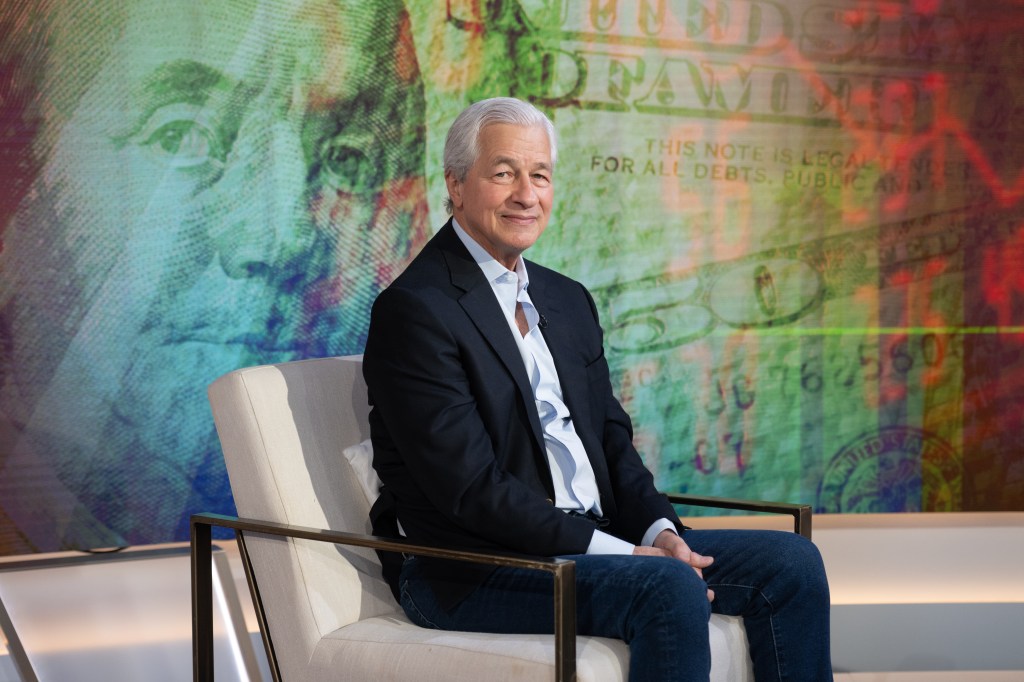

Jamie Dimon just submitted his annual letter to shareholders, noting in stark terms how he views the geopolitical environment and the importance of economic alliances across industry participants and governments, and what these alliances could mean for security and economic stability.
He discussed AI, banking regulations, geopolitical risk, and the general risk-management lessons he has learned over the years.
Dimon is a highly influential presence on the global financial services stage, serving as Chair and CEO of JPMorgan Chase since 2006. He helped navigate the 2008 financial crisis, and built the largest US bank. He often offers blunt commentary on global economics, evolving technology, and impending risks to the markets, and his latest annual shareholder letter is worthy of note.
JPM’s size as a strength and weakness
Of course, the document is designed to talk about the company’s performance, and Dimon had a lot to be proud of here, reporting $185.6 billion in revenue and $57 billion in net income, with a return on tangible common equity near 20%.
During the period covered, the bank increased its quarterly dividend twice. The company now has $4.4 trillion in assets. But Dimon acknowledged that this can be both a strength and a weakness.
“Size can often be a tremendous business disadvantage because it frequently comes with the baggage of complexity, bureaucracy and complacency,” Dimon wrote. “It can slow down decision making, generate arrogance and cloud the essential focus on seeing the world through the customer’s eyes.” He warned against complacency, noting that fintech firms such as Block, Revolut, and others are making inroads with their payment products and services.
Geopolitical events and trade
Dimon mentioned the fragility of the global economy, specifying “elevated” global deficits and “high global sovereign debt” in particular as a problem “that will eventually have to be dealt with … the wrong way would be to let it become a crisis, which, in my opinion, is probably the likely outcome,” he said.
He noted the ongoing conflicts in Ukraine and tensions in Iran, alongside broader geopolitical friction in the Middle East and their effect on “countries and economies across the globe” – not just in terms of energy, which he certainly mentioned, but also commodity products that are “byproducts of oil and gas, like fertilizer and helium.”
He went on to say: “And given our complex global supply chains, countries are experiencing disruptions in shipbuilding, food and farming, among others. The outcome of current geopolitical events may very well be the defining factor in how the future global economic order unfolds – then again, it may not.”
He also hopes that US and China relations can improve, as their engagement is “critical to the whole world.”
Observing that US tariffs have had a minor effect on inflation or growth, he said that “trade battles are clearly not over,” and the conversations that nations are having now about how and with whom they trade is “causing a realignment of economic relations in the world.”
He went on to say: “While some of this is necessary for national security and resiliency, which are paramount, it is hard to figure out what the long-term effects will be.”
AI adoption
Dimon said the pace of AI’s implementation will be “transformational,” but he can’t be sure how the AI revolution will unfold. “Overall, the investment in AI is not a speculative bubble; rather, it will deliver significant benefits. However, at this time, we cannot predict the ultimate winners and losers in AI-related industries,” Dimon said.
“We will not put our heads in the sand. We will deploy AI, as we deploy all technology, to do a better job for our customers (and employees),” he wrote.
“We have focused on some of the ‘known and predictable’ and some of the ‘known unknown’ events,” he said. “But huge technological shifts like AI always have second- and third-order effects as well that can deeply impact society … We should be monitoring for this kind of transformation, too.”
Dimon’s firm is no stranger to AI and harnessing its power to gain a competitive edge. The firm is using agentic AI to complete complex tasks for employees, with its chief data analytics officer last September showing CNBC how the AI program could build an investment banking deck in 30 seconds.
Earlier this year, Dimon addressed his company’s plans to reassign employees as technology shifted job functions. “We already have huge redeployment plans for [our] own people,” Dimon said. “We have displaced people from AI – and we offer them other jobs,” he said, according to CNBC.
Some overwrought bank regs
Dimon lamented not all but at least some of the regulations that were put into place after the 2008 financial crisis, saying a number of them “created a fragmented, slow-moving system with expensive, overlapping and excessive rules and regulations – some of which made the financial system weaker and reduced productive lending.”
He specifically cited negative consequences of capital and liquidity requirements, the current construction of the Federal Reserve’s stress test, and also said that JPMorgan’s reaction to recently revised proposals for Basel 3 Endgame and a global systemically important bank (GISB) surcharge were “mixed.”
“While it was good to see that the recent proposals for the Basel 3 Endgame (B3E) and GSIB attempted to reduce the increase in required capital from the 2023 proposals, there are still some aspects that are frankly nonsensical,” Dimon said.
Dimon said that, considering the aggregate proposed surcharges of about 5%, the bank would need to hold “as much as 50% more capital across the vast majority of loans to US consumers and businesses when compared with a large non-GSIB bank for the same set of loans.”
“Frankly, it’s not right, and it’s un-American,” he wrote.
European resilience as a need-to-have
Dimon says “we believe that a stronger Europe, militarily and economically, is in America’s self-interest,” and that America could help by offering Europe “one unbelievable inducement: If it commits to economic and military reforms, the United States would negotiate one big, beautiful free trade agreement with all of Europe.” (He used the boldface.)
He then added: “If I could, I would throw in similar action with Australia, Japan, the Philippines, South Korea and other nations. This would be an economic and geopolitical home run for the United States and for Europe, allowing us to set the global rules around trade (if you want to access to over 40% of the world’s market), and it would bind Western allies together in the face of autocratic pressure.”
He thinks if these nations could settle some tax and regulatory issues, such as those related to climate reporting, and if nations could be more flexible about “one of the most challenging issues – agriculture” the benefits “would be enormous.”