
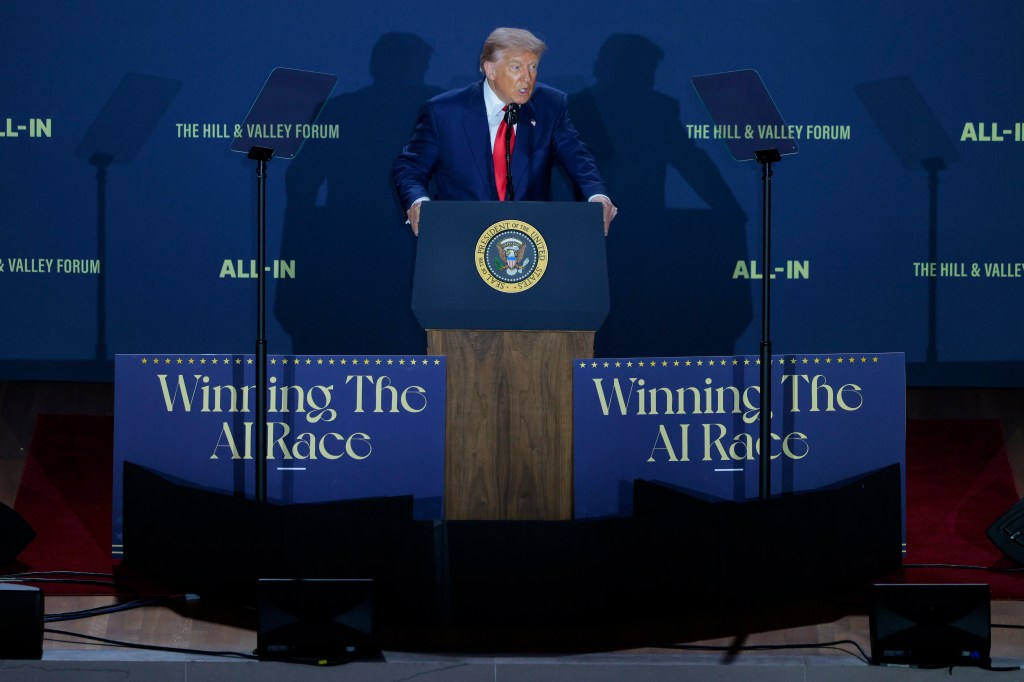

The White House released a new framework for national AI legislation last Friday, focusing on protections for children while advocating for limits on legal liability for developers, no “censorship” of “lawful political expression” and the reining in of “conflicting” state laws that the White House says could slow down the technology’s development.
Now a legislative framework must come from Congress, so the itemized list President Trump enumerates is his executive team’s suggested blueprint of priorities for the legislative branch of government to follow.
Against this backdrop, several House Democrats, namely, Doris Matsui (D-CA), Ted Lieu (D-CA), Sara Jacobs (D-CA), April McClain Delaney (D-MD), and Don Beyer (D-VA), introduced a bill (also on Friday) that would repeal Trump’s December executive order that directly aimed at overriding state AI laws. Senator Elissa Slotkin (D-MI) introduced a bill to establish limits on how the Department of Defense can use AI.
We will see what happens as contentious midterm elections approach, which could change the Democrat-Republican balance in Congress, and as the ever-powerful tech lobby weighs in on the industry side.
But the White House’s itemized list reflects executive orders and other documents President Trump and his cabinet have released on the topic of AI already, and has bipartisan elements to it (such as a focus on children’s safety), so it’s developing into a tug-of-war and a compromise will be needed.
Six key objectives
The Trump Administration’s framework “addresses the most pressing policy topics that AI presents,” and includes:
Protecting children
The framework calls on Congress to give parents tools to manage their children’s digital experiences, “such as account controls to protect their children’s privacy and manage their device use.”
Strengthening American communities
The framework doesn’t want the public to be financially responsible for the increased energy demands imposed by data centers. It says: “The Administration believes that ratepayers should not foot the bill for data centers and is calling on Congress to streamline permitting so that data centers can generate power on site, enhancing grid reliability.”
Respecting intellectual property and supporting creators
In the full report, the Administration begins with the premise that “the training of AI models on copyrighted material does not violate copyright laws” and recommends against wading into the legal fights between artists and creators, instead letting the courts decide these issues.
It goes on to say that “Congress should consider enabling licensing frameworks or collective rights systems for rights holders to collectively negotiate compensation from AI providers, without incurring antitrust liability.” The White House does not believe that Congress should dictate when or whether this licensing would be required.
Preventing censorship and protecting free speech
The framework states that “Congress should prevent the United States government from coercing technology providers, including AI providers, to ban, compel, or alter content based on partisan or ideological agendas.” This is reflective of President Trump’s approach (via executive orders in particular) to ensure there is no censorship of political viewpoints on communication platforms. He has claimed the Biden Administration imposed “substantial coercive pressure on third parties, such as social media companies, to moderate, deplatform, or otherwise suppress speech that the Federal Government did not approve.”
Ensuring American AI dominance
The framework says Congress should establish regulatory sandboxes for AI development and that “Congress should provide resources to make federal datasets accessible to industry and academia in AI-ready formats for use in training AI models and systems.”
Developing an AI-ready workforce
The framework encourages “Congress to further workforce development and skills training programs, expanding opportunities across sectors and creating new jobs in an AI-powered economy.” One such way to do it is to make sure “existing education programs and workforce training and support programs, including apprenticeships, affirmatively incorporate AI training,” it says.
Deeper dive
The US House Committee on Financial Services Chair French Hill (R-AR) on Friday commended President Trump “for releasing a thoughtful National Legislative Framework for AI that pairs innovation with targeted safeguards. As Congress moves forward, advancing regulatory sandboxes and a flexible, sectoral based approach will be critical to enabling responsible development.”
“States should not be permitted to regulate AI development, because it is an inherently interstate phenomenon with key foreign policy and national security implications.”
The White House’s National AI Legislative Framework
And White House “AI Czar” David Sacks wrote in a social media post last Wednesday about the framework that “[t]his was in response to a growing patchwork of 50 different state regulatory regimes that threaten to stifle innovation and jeopardize America’s lead in the AI race.”
Sacks said the next step is to work with Congress to turn the administration’s principles into federal legislation.
Again, this could be tough even though the framework appeals to some bipartisan concerns regarding potential harms to children and skyrocketing electricity costs. Democrats through their own initiatives also want to rein in the powerful tech industry and its lobby, gaining the assurance that AI companies will be held accountable for the harms posed by their tools, such as chatbots.
And how much oversight states have here could remain an issue, as the White House’s framework boldly addresses states’ rights to regulate developers this way: “States should not be permitted to regulate AI development, because it is an inherently interstate phenomenon with key foreign policy and national security implications.”
But the White House’s framework does factor in some state-level regulatory powers over AI, including saying that Congress shouldn’t interfere with local authorities in deciding where to place data centers and other AI infrastructure, or how states procure their own AI tools for law enforcement or education.