


KPMG’s latest report on AI says the question is no longer whether organizations can deploy AI, since most already have. It’s whether they can manage it rigorously enough to turn deployment into durable, measurable value. That shift from experimentation to economic discipline defines this quarter’s findings.
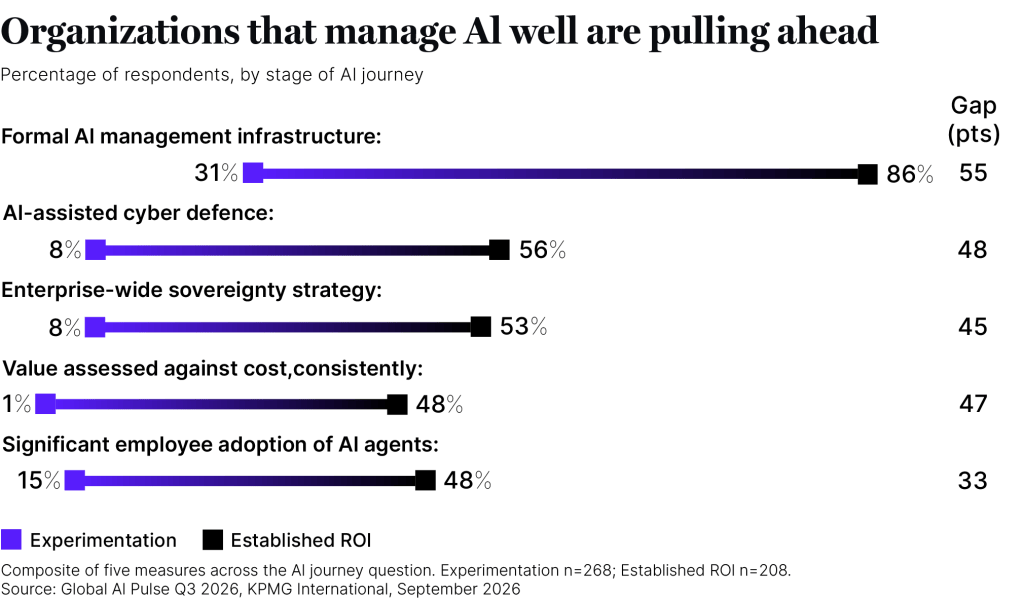
The Global AI Pulse Q3 2026 draws on conversations with 2,131 senior leaders across 20 countries, and shows that planned AI investment has risen to an average of $210m over the next 12 months, up from $186m in Q1. While 89% of organizations report measurable value from AI, only 12% consistently assess that value against cost. That figure rose to 48% among organizations already reporting returns, but still leaves the majority flying without a clear economic instrument panel. 61% review costs at approval and 59% monitor them in operation, but few connect that spending to outcomes on an ongoing basis.
For organizations that have established return on investment from AI depoloyment the management of the layer between AI models and business use cases sits firmly at the enterprise level. “Nobody in a boardroom is asking whether to do AI. They are asking why they are not getting value yet, and what has to change to make it stick. The answer is rarely the model, and more commonly the answer lies in how the broader enterprise adapts,” Simon Benson, KPMG Australia’s regional AI lead for ASPAC, says.
One of the report’s more striking findings is that AI maturity is converging worldwide. The spread between leading and trailing regions has halved, from 16 points in Q1 to just 8 points in Q3. Early movers’ advantage is narrowing as laggard markets catch up, which raises the stakes for organizations relying on first-mover positioning rather than operational discipline to differentiate themselves.
Productivity gains remain a key operating priority for AI model deployment, but, as further evidence of successful implementation, have dropped by five percentage points while other priorities including human-AI collaboration and security have gained ground.
The data draws a sharp line between organizations with formal AI management infrastructure and those without. Overall, 55% of organizations operate such infrastructure, but that number jumps to 86% among organizations with established returns, a gap that suggests governance isn’t a compliance afterthought but a precondition for value capture.
Accountability is also consolidating. 53% now place responsibility for AI-informed decisions at C-suite level or above, but within the management layer itself, capabilities are uneven. Security and identity controls are relatively mature at 43%, while model routing (the capability for choosing the appropriate model for a specific task), at just 23%, lags as the least-developed capability. Meanwhile, employee adoption of AI agents is accelerating, with 34% of organizations reporting significant uptake, up from 25% in Q1.
Cybersecurity, sovereignty and provider dependency are converging into a single resilience conversation. The vast majority (86%) are adapting their cybersecurity operating model specifically for AI-accelerated threats, and the budget data reflects a maturity divide. Some 71% of established-ROI organizations direct AI budget toward cyber and data security, compared with just 36% of experimenters.
Sovereignty is emerging as a harder constraint than many expected, with 21% now running an enterprise-wide model sovereignty strategy under regular review, and a further 51% applying formal criteria to most or selected decisions. Notably, 8% report that sovereignty concerns are already slowing their AI deployment, a small but telling signal that geopolitical and regulatory considerations are starting to shape technical architecture decisions, not just legal ones.