
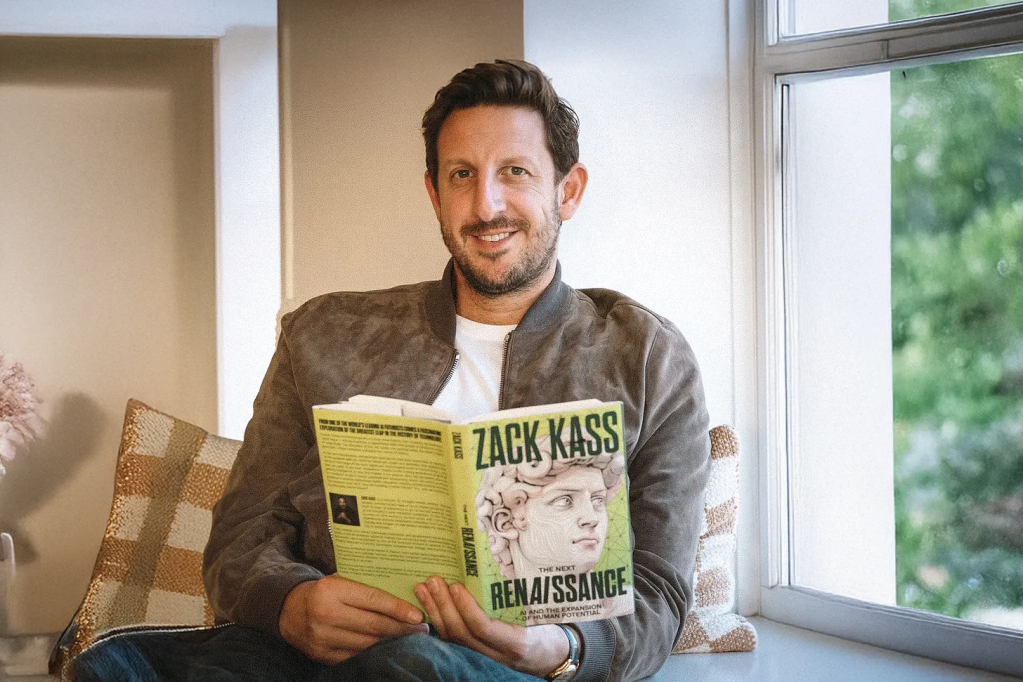

Zack Kass is one of the leading AI strategists that government and Fortune 500 executive leaders turn to for his perspective on how strategy can align with governance, and in a way that leaders can use to navigate rapid technological change while bringing key stakeholders along.
He was one of OpenAI’s first 100 employees and served as its Head of Go-To-Market, helping the company go from a start-up research lab into an institution that is navigating the development of revolutionary tools. He has taken that experience to weigh in on conversations about the ever-expanding technology being held on global government agency and multinational corporation levels.
He wrote a fascinating book that blends an understandable history of artificial intelligence (AI) and offers a forward-looking roadmap for people like me – interested, willing to learn, but without an expertise in technology. It is called The Next RenAIssance: AI and the Expansion of Human Potential, published in January 2026 by Wiley.
This is not a book review, although I encourage GRIP readers to read the book; it offers clear guidance on how AI can uniquely deliver new solutions if the businesses and individuals creating and championing them can showcase the tangible gains it is delivering already.
Kass offers it as a tribute to a technology he believes will solve previously unimaginable challenges, presenting entirely new possibilities. But he remains seriously focused on the barriers to AI adoption, from social inequality to employment-based (and other) discernible disincentives in embracing it.
Stakeholders need to believe
I asked Kass how people like him can bring diverse stakeholders together closer to help ensure the best features of the technology are realized and even larger buy-in is achieved?
Kass: I do think the future depends on many stakeholders, but the assumption that change requires mass coordination is itself part of the paralysis. In practice, a lot of disengagement comes from people assuming the only way to matter is to influence systems at massive scale. And while policy, research, and industry leadership absolutely matter, most people still experience the world locally; through schools, workplaces, neighborhoods, businesses, and families.
In practice, that’s where most of the leverage is. I’ve been spending time with teachers, parents, school administrators, local officials, and business owners because those are the people already shaping the environments we live in. I’m trying to show them something simple – you do not need to solve AI. You can exercise agency in this moment by focusing on what is directly in front of you. If a teacher builds a classroom where kids are curious and challenged, that matters.
If a parent makes the dinner table somewhere their children want to be, that matters. If a city invests in its parks, libraries, and main streets, that matters. If enough people do this, you end up with a physical world that’s actually worthy of our attention.
I told Kass that I loved one of the main points in his book – that the paradox of our times is that undeniable progress (in life expectancy, productivity, healthcare advancements) paired with intolerable dysfunction (they still cost too much, deliver too little, leave some people behind) – but that AI can help.
But how do we convince people of this? And will it really be AI that helps us create “hospitals that prevent illness instead of profiting from it?” That’s a tough industry lobby to beat.
Kass: Doctors now spend nearly twice as much time on administrative work as they do with their patients. Hospitals spend twice as much on administrative costs than patient care costs. Healthcare is expensive in large part because we are remarkably inefficient at delivering it, and the patient ultimately absorbs that cost. Billing, documentation, insurance approvals, redundant testing; these are exactly the forms of vicious friction AI should eliminate.
When doctors spend less time navigating bureaucracy and more time practicing medicine, outcomes improve, costs fall, and care naturally begins to shift from treatment toward prevention. At the same time, access to medical intelligence itself begins to expand. For most of human history, quality healthcare has been constrained by geography and income. Your outcomes depended heavily on where you lived, what institutions existed nearby, and whether you could afford access to expertise.
AI weakens those constraints by making intelligence more distributable. A clinician in a rural community can increasingly access the same research, diagnostic support, and analytical capability as a specialist at a major institution. As intelligence becomes cheaper and more abundant, the cost of delivering meaningful care falls alongside it.
Institutions tend to optimize around the systems and constraints they inherit. Historically, entrenched systems change when new technologies alter the underlying economics and incentives beneath them. AI creates the possibility of doing exactly that in healthcare.
AI risk
I had to bring up Mythos, pointing out that Anthropic’s Claude Mythos Preview announced last month is an AI model capable of autonomously finding and exploiting zero-day vulnerabilities in critical software faster than human experts. While intended for security testing, its potential for misuse has raised global cybersecurity concerns.
Even if this company or OpenAI can tune, test and monitor their tools for consistence, or even shut them down, this threat is causing global concern.
So I asked how can risks in the development of AI stop multiplying so AI skeptics and others can finally feel better about actually learning and using them?
Kass: The risk isn’t going to stop multiplying. We need to be honest about that. We need to get serious about the two best levers we actually have. The first is technology. I know how that sounds. People laugh – the solution to AI problems is more AI? Convenient. It’s true. The way we fight cybercrime is by building technology that makes us better at fighting cybercrime. That has always been true. Historically, technology tends to move the wheels of justice in the right direction.
Over time, it favors the good actor. But we can’t just wait for that to happen. We need to use our second lever, which is policy. Exceptional punishment is terrifying, and it works. Most bad actors are risk-adjusting. They’re doing a calculation. So make the math stop working.
Florida passed a policy that says if you get caught attempting to steal from a senior citizen using technology, broadly defined, you get extradited back to Florida and tried for up to 25 years. Good. Make it genuinely costly to use inexpensive technology to tear at the fabric of society, and most people will stop. And that starts with the average person putting pressure on the people making decisions.
Technology does not absolve us of responsibility. It concentrates it. The people who engage now are the ones who get to shape how this lands.
Industry adoption and leadership messaging
I told Kass I was not sure businesses are doing a good job making their employees feel more comfortable with AI tools before deploying them. And I’m not sure prohibitions work either (that “shadow AI” concept seems pretty real), so what would his messaging be to boards and executive leadership about the need for upskilling and an allowance of AI use to breed familiarity?
Kass: The framing I’d push back on is “upskilling.” That word implies the problem is a skills gap. It isn’t. The problem is an identity gap. When you deploy AI into an organization without bringing people along, you’re not just asking them to learn a new tool. You’re asking them to renegotiate their sense of professional worth. That’s a much harder ask, and most leadership teams are not treating it that way.
“My greatest fear is that we sleepwalk into a future we didn’t choose. … If the cost of living doesn’t decline, and we don’t see cures for devastating diseases, the reasonable conclusion will be that AI is not delivering value to the average person, and the backlash will be severe, no matter what else we solve.
Zack Kass
What I say to boards is this – help your teams understand that employers are beginning to care much less about any current skill and much more about the ability to learn the next one. If you believe that, and you should, then your culture, your reward systems, and your incentives need to reflect it. Most don’t. Most organizations are still measuring and rewarding people on the old model while simultaneously asking them to adopt the new one.
That’s a recipe for exactly the shadow behavior you’re trying to avoid. In a world that changes a lot, anchor to what you believe, and be unwavering in those things – your mission, your values, your purpose – so that you can be adaptable in your ways and means. That applies to organizations as much as it applies to people. Protect the purpose. Evolve the rest. Give people permission to experiment inside that clarity and you will have an advantage.
Does this mean we need more AI expertise at the board level now?
Kass: Yes. But AI isn’t something that gets solved at one layer of the organization. You need board members who understand it – absolutely. But that’s just the top of the stack. The whole organization has to anchor on mission, vision, and values, and be genuinely adaptable in its ways and means. That means rebuilding incentive structures.
That means managers measuring their teams differently. That means hiring for learning ability, not just current skill. That means bringing people along in the journey rather than deploying at them. A board that gets it but a middle management layer that doesn’t will fail. Every time. This isn’t a governance problem. It’s a culture problem.
His greatest source of optimism and concern
I asked Kass what his greatest concern and largest source of optimism was right now concerning AI development and use.
Kass: I think we often describe this moment as primarily an economic or technological transition, but underneath it’s a human one. AI is forcing us to ask deeper questions about meaning, purpose, status, creativity, and what we actually value. For decades, much of society built identity around productivity and labor scarcity. We are now entering a world where intelligence itself becomes increasingly abundant. That changes the equation.
Abundance is morally neutral. Access to the internet does not make everyone thoughtful. Literacy does not guarantee wisdom. Unmetered intelligence will not magically produce a world of brilliant, fulfilled citizens. It simply means humanity is gaining access to extraordinary cognitive leverage. What we choose to do with it will define our outcomes.
My greatest fear is that we sleepwalk into a future we didn’t choose. That we let this moment slip by without asking the hard questions – about what we’re protecting, what we’re distributing, and who actually benefits. Because if the cost of living doesn’t decline, and we don’t see cures for devastating diseases, the reasonable conclusion will be that AI is not delivering value to the average person, and the backlash will be severe no matter what else we solve.
Over the last few years I’ve connected with hundreds of thousands of people all over the world – from boardrooms to union halls to classrooms – and I do not believe optimism is naive. People want hope and they want agency.
The fatalism we see today isn’t a lack of care. It’s the opposite. It’s what happens when people are inundated with negative information about problems they can’t see, touch, or change. Redirect that energy toward what’s right in front of you, and everything looks different. People don’t want this moment to slip away from them. And from everything I’ve seen – I don’t think it will.