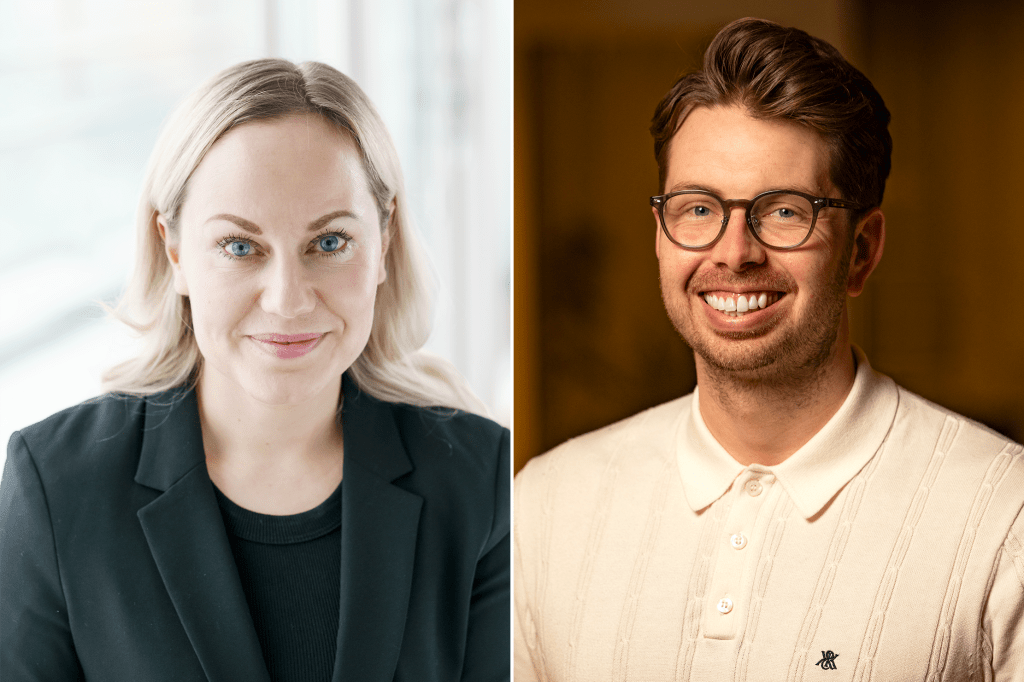

Following up the first part of the NNAI series, in which Cecilia Leveaux, senior adviser at the Nordic Council of Ministers, walked us through the story of how New Nordics AI came to be, this second part turns to the operational aspect of the initiative.
We spoke with the interim co-leads at NNAI, Gísli Ragnar Guðmundsson and Iida Lähdemäki, who told us about the upcoming activities, expectations, and future plans.
Gísli and Iida, tell us about yourselves.
Iida: My name is Iida Lähdemäki, and I am the COO of AI Finland. AI Finland is a national business network for the acceleration of AI adoption and development in Finland. In parallel, I am also the interim co-lead for NNAI. I have been involved in the initiative almost from the beginning and soon after the formation of AI Finland. I am happy to see that the NNAI collaboration has started to bear fruit.
Gísli: I come with a background in AI policies, working at Iceland’s Ministry of Higher Education, Science and Innovation. Now, I am part of the Icelandic Centre for Language Technology, Almannarómur, which has been working on preserving the Icelandic language in AI technology solutions. For example, these efforts have led to Icelandic being the second language, after English, used in ChatGPT. Finally, I am happy to co-lead the NNAI together with Iida.
NNAI was launched with a clear goal to strengthen AI collaboration across the Nordic and Baltic ecosystems, while leveraging joint values and regional advantages. What was the added value that led to your organizations joining NNAI?
Iida: Something that is immensely important to us is that we are building a unique initiative – we are not trying to replicate or compete with something that already exists on a national level.
A very tangible benefit we saw was the opportunity to take the national activities into the Nordic ecosystem, to learn what others are doing, improve speed and efficiency, and scale certain best practices. This all helps us speed up AI development and adoption.
“Our task is to work out a ‘Nordic AI way’ that asks how we can approach AI responsibly and find the right balance between efficiency and keeping citizens involved.”
Gísli Ragnar Guðmundsson
Gísli: I echo Iida’s take on this. For us in Iceland, as a small country, it would be harder to compete and stay up-to-date on AI developments without large-scale Nordic cooperation. This also allows us to identify any area we could take the lead on.
The collaboration logic lies in the common points between the public sector and core infrastructure across the Nordics. For example, if the tax authorities in Sweden developed an AI solution that works for them, it may very likely work in Iceland. So, instead of all of us working in our separate corners, NNAI helps us share ideas across the region.
What are some other shared traits you see across the Nordics that could give the region a competitive edge?
Iida: We score high in digital readiness, we have high-trust societies, welfare models, and institutions that work well. This gives us a good foundation and grounds to punch above our weight – but that foundation alone is not enough to build a competitive edge in the AI era.
With the capabilities and competences at hand, we should be able to run an AI transformation in our public sectors that would enable us to maintain the welfare states we have built. On the flip side, we need to do that to tackle joint challenges such as aging population or reduced workforce. At the same time, we are, together with the Baltics, whose national associations are set to join NNAI this fall, countries that are small enough to move fast and act as test labs for certain AI initiatives.
“Throughout 2026, we are aiming to build an AI Support Hub for the public sector, Nordic companies, and relevant authorities.”
Iida Lähdemäki
Gísli: Our task is to work out a “Nordic AI way” that asks how we can approach AI responsibly and find the right balance between efficiency and keeping citizens involved. One specific angle that NNAI’s Board Chairperson, Katrín Jakobsdóttir, a former Prime Minister of Iceland, wants to leverage is gender equality – that is, how to use AI without degrading the high level of gender equality in the region.
In the first article, there was mention of a mapping exercise that was about to start, tied to the national ecosystems and potential sectoral synergies.
Gísli: In terms of the ecosystem mapping, the exercise is still ongoing – we have mapped the AI start-ups in the region and the available funding opportunities. We want to continue mapping out the entire AI ecosystems in each of the countries, and assess our advantages, value chains, and how independent the Nordic region is in the AI context.
Iida: For the mapping of synergies and collaboration areas – a couple of weeks ago we gathered in Copenhagen to work on the next steps and projects. As an example, the public sector AI transformation is something where we see similar challenges and possibly immediate benefits from closer collaboration.
Gísli: When it comes to healthcare, there is an ongoing mapping of AI use cases, carried out by AI Sweden.
Speaking of the EU AI Act, one of NNAI’s project initiatives, the EU Act Implementation Network, has now moved into its next phase.
Iida: We are at the moment engaged with another project called Nordic AI Union, which is a form of a pre-study on what would be needed for the setup of a joint Nordic sandbox. The project is soon to be completed and NNAI will build on that work.
Throughout 2026, we are aiming to build an AI Support Hub for the public sector, Nordic companies, and relevant authorities. We have had high interest from all countries and plan to engage the national nodes, who will pull in stakeholders and counterparties. So more than the NNAI membership will be involved.
During your interactions with companies, what surprised you most – in terms of the biggest challenge or greatest competence gap?
Gísli: Overall, what is lacking is more data and AI governance in companies. In Iceland, companies tend to have small IT teams, with external auditors doing most of the audit work. Moving forward, we will need some form of AI model auditing – assessing how you are using AI and if it is within the AI Act rules. That type of skillset is lacking. It may translate into more lawyers and auditors moving into the tech sphere, understanding how technology works and how to support companies.
“The key message to companies completely new to AI and starting their journey today is: just start!“
Iida Lähdemäki
Iida: Most of the companies are eager to see more on interpretation, for example what the AI Act means in real-life scenarios. We see NNAI having an active role in sparking discussion and dialogue between the regulators in making sure that we do not hinder innovation through regulation.
The EU AI Act was just subjected to changes, as part of the Omnibus initiatives across the EU. Does this affect NNAI’s work?
Gísli: It is a challenge to regulate something that is developing so quickly, but it is even harder for companies who need to understand implementation. Our task remains to make it as easy as possible for companies and the public sector to be on the right side of the AI Act and not be afraid of breaking the rules.
Iida: We, of course, follow the developments, but our role in the big picture scenario would remain intact. In times of uncertainty, we may need to provide even more support, for example through bringing authorities and companies together for knowledge sharing.
If you think about companies that are completely new to AI and want to start their journey today – what advice would you give them?
Iida: The key message to those companies is: just start! In Finland, a frequent question we get, especially by SMEs, is where to start? One answer is to speak to an ecosystem initiative; they are usually eager to share learnings and advice.
Then, there are two areas where companies need to be active. First, the broad-scale adoption within the organization – and it won’t happen if employees do not receive appropriate tools and training. Secondly, Nordic companies need to consider the areas where they can build new or transform an existing business to remain competitive. Most companies focus on the first one but less on the latter, which is as important.
If we imagine the EU AI Act implemented and companies on their AI journeys, where would you see a need for more research or more projects?
Gísli: It is difficult to pinpoint one issue; I believe all sectors will be heavily impacted. But one thing that I would like to see, both in companies and governments, is more creative thinkers.
The issue that I have been running into, related to Iida’s “where do I start” question, is the understanding that no one can come into your company and tell you where your exact starting point is. You need to be able to combine understanding of the technology with understanding of how your company works in coming up with new, fun, and creative solutions.
“One thing I would like to see, both in companies and governments, is more creative thinkers.”
Gísli Ragnar Guðmundsson
We have seen a large push in Iceland for STEM, but we need more people from creative backgrounds as well as people able to share historical approaches so we can adopt the new technology in an informed way.
Looking into the future, what are some immediate milestones for the NNAI? And over the longer term, what is the one change that you hope NNAI will make?
Gísli: In addition to finalizing the activities discussed in Copenhagen, one immediate project that we are all aligned on is responsible AI – or what a Nordic approach would entail. The explanation behind responsible AI has so far been quite vague and difficult for people to understand. We want to bridge that and hopefully present a more palatable take towards the end of the year.
Over the longer term, and in addition to increasing our own visibility, we aim to increase regional digital literacy, the level of collaboration, and to help create tools that support implementation, compliance, and signal needs for information and deep dives.
Iida: If I look at the big picture, the NNAI involves hands-on collaboration between five, soon to be eight, countries. Such collaborations are not easy – but they are unique and full of potential. I hope we can build the NNAI into a collaboration model that can add value beyond the Nordics and Baltics and be replicable in other regions.