


Adobe Express surveyed over 1,000 adults in 24 industries across the UK to find out how people are using AI in their everyday lives, both at home and at work, in an effort to understand real-world AI habits.
Findings show that 40% are already using AI, with over two-thirds of people reporting a boost in productivity.
But roughly one-third of people are concerned about data privacy and struggle with understanding or using AI tools.
Of those working in IT (information technology), almost three-quarters (73%) use AI for sourcing information and almost half (47%) use AI for software development.
Rates of use in other professions were:
- design and content creation (70%);
- research and information gathering (56%);
- data analysis (46%);
- project management (40%);
- communication (22%);
- software development (18%).
Sectors such as environment and agriculture, and hospitality and events, report the biggest time savings, with 50% in each saving over 10 hours per week. However, challenges remain, as 100% of those in science and pharmaceuticals avoid AI due to lack of training, and privacy concerns affect up to 100% in marketing.
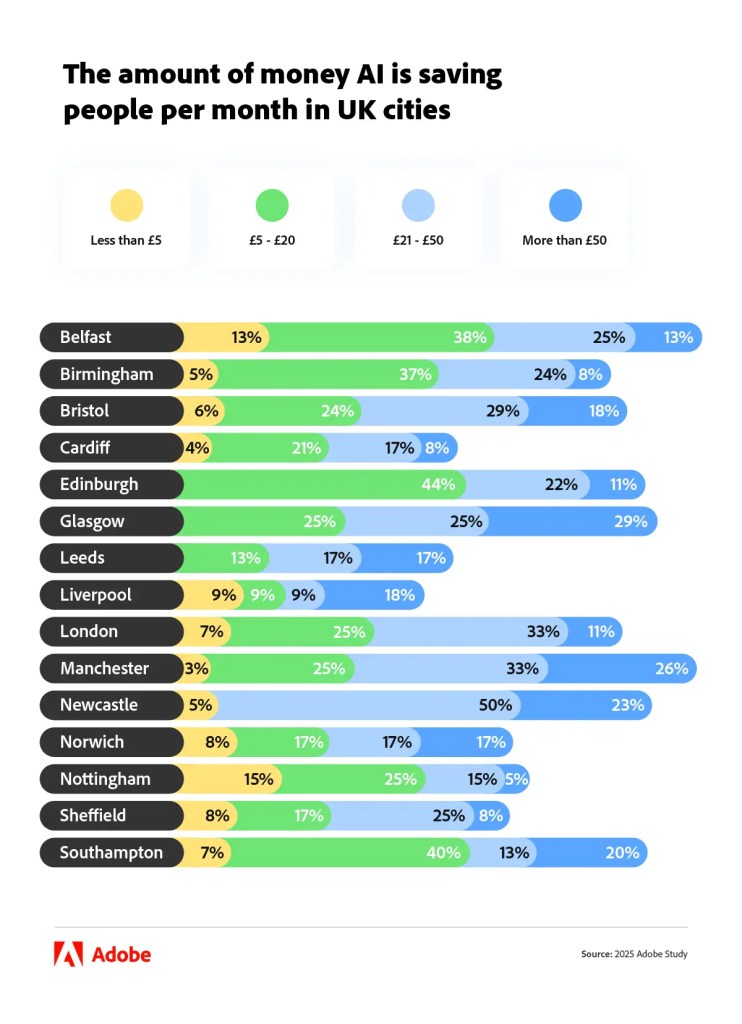
Regional variations exist regarding AI’s perceived utility. Respondents in Southampton had more positive views than those in Leeds.
In Belfast 100% reportedly use AI tools for writing and content creation, while more than two-thirds (71%) of those in Manchester prefer to use AI for data analysis and interpretation.
And use varies by profession, with 100% of those working in law predominantly using AI to support content creation and communication tasks, compared with 80% in recruitment and HR.
But creatives are concerned about the implications of incorporating the results of AI into their work.
“The death of the author is upon us. Publishers have actually asked me if I’m available to edit an AI-generated manuscript. The argument that they only want original creative expression is not the real reason for a publisher to cancel a book,” ghostwriter Joshua Lisec says.
“The real reason is that it’s a copyright issue. The US Copyright Office is very clear that you can creatively incorporate AI output into human-written material and still copyright it. But if you don’t sufficiently edit the text, you have to include in your copyright application a disclaimer on which parts you used AI for because those parts are not copyrightable.”