
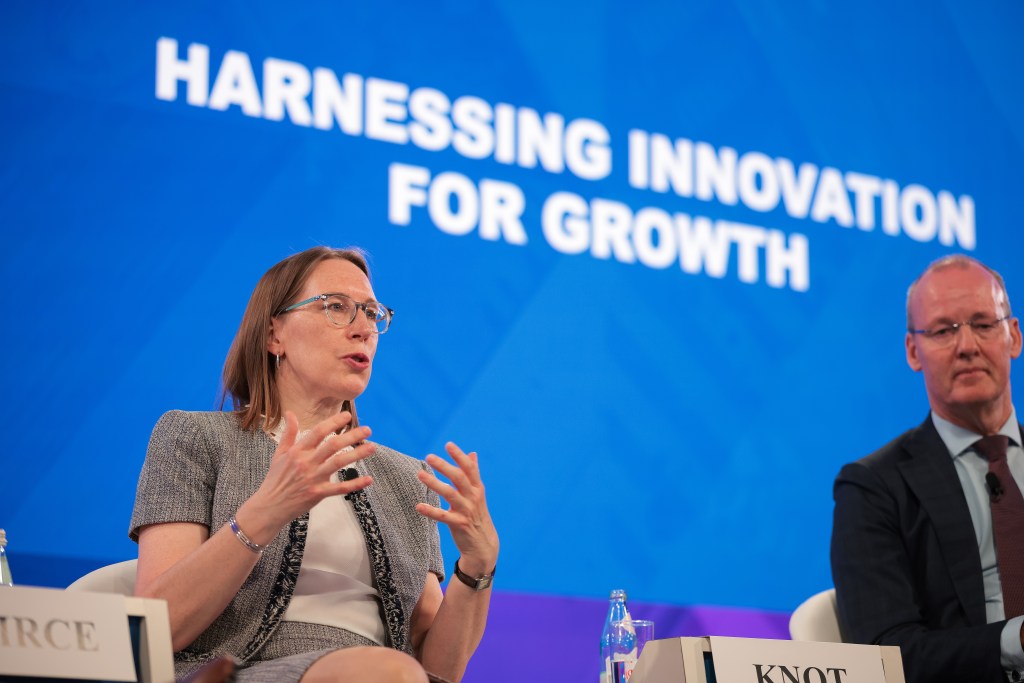

In prepared remarks issued on Tuesday at the US Chamber of Commerce Capital Markets Summit, SEC Commissioner Hester Peirce spoke of her love for exploring financial regulatory issues. She detailed the goals accomplished and those she sees lingering for the US securities watchdog.
Why is she so proud of the US capital markets? Because they “embrace and support risk-taking innovations that propel human progress.” She acknowledged that “innovation is a risky business.” But the good news is that the “capital markets absorb these failures and redirect capital to new endeavors.”
Peirce credited the resilience of the US markets to the government’s general lack of meddling with them. She also credited it to the fact that US law dictates regulation not be merit-based, meaning our capital markets “will include products, services, and practices that some members of the Commission and the staff personally disfavor.”
Recent noteworthy SEC actions
Peirce listed several recent SEC efforts to streamline and tighten up the parameters within which the agency exists, which she views as more in keeping with what the US Constitution and Congress dictate.
- Don’t admit, but you can deny: Last month, the SEC rescinded its policy of requiring people and businesses that settle with the regulator to not deny the allegations that form the basis of the settlement action. She said the old rule “raises First Amendment concerns.”
- Climate disclosure rules: “In my view, those rules required disclosures not authorized under our statutes.” When the climate rule was adopted in 2024, and again in late May of this year when it was rescinded, Peirce expressed her concern that the agency was exceeding its statutory authority by crafting a highly prescriptive and expansive set of disclosures designed for a purpose other than informing investors.” She said there were other places to go for information about greenhouse gas emissions and other climate-related issues; mandated disclosures should revolve around materiality.
- Regulation S-K: This regulation drives the structure and content of annual and quarterly disclosures, and SEC Chairman Paul Atkins has remarked that its requirements have grown “to the size of an artificial-intelligence data center” over the past 40 years, “burying shareholders in an avalanche of immaterial information.”
- Form PF: Peirce says the confidential reporting form used by registered investment advisers to private funds to report regulatory assets under management and monitor systemic risks has become lengthy and burdensome over the years, requiring reporting that exceeds its underlying statutory framework (the Dodd-Frank Act).
- The Consolidated Audit Trail (CAT): Peirce bluntly refers to it as “a massive market surveillance monitoring operation.” She points to the SEC’s April concept release on this regulatory database that was created to track all equity and options trades across US markets. That release “asks questions related to the CAT’s implications for civil liberties and privacy.”
- Cryptocurrency: Peirce, widely dubbed across the crypto industry as “Crypto Mom” for advocating for clearer digital asset rules, said that the SEC’s work on crypto over the last 18 or so months reflects its effort “to tie our crypto regulatory and enforcement activities to the statutes we administer.” When the SEC was helmed by former chair Gary Gensler, Peirce repeatedly condemned the SEC’s reliance on litigation and enforcement against crypto firms, describing it as a “paternalistic and lazy” way to regulate that created a “regulatory version of an escape room.”
Work to be done
Peirce noted the work ahead for the agency, pointing first to the constitutionality of the pay-to-play rules as a concern for the agency to grapple with soon, citing free speech concerns.
“Prohibiting advisers who make political donations from providing advisory services to governmental customers creates significant financial disincentives from making those donations and from running for office,” Peirce stated.
Since the rule “effectively regulates speech,” she contended, “we ought to ask ourselves whether the rule is really the least restrictive means to achieving the desired objective: preventing public corruption.” Going further, she wonders if the objective of pursuing public corruption is one Congress intended as part of the SEC’s remit.
Peirce repeatedly condemned the SEC’s reliance on litigation and enforcement against crypto firms, describing it as a “paternalistic and lazy” way to regulate that created a “regulatory version of an escape room.”
Peirce also targeted a law signed by President Jimmy Carter back in 1977, the Foreign Corrupt Practices Act (FCPA), saying the SEC “should bridle its overly expansive reading of the [law’s] requirements that companies devise and maintain a system of ‘internal accounting controls.”
Peirce (like some other critics of its interpretation through the years) thinks the SEC has failed to limit this provision “to the accounting context” and has instead used it “as a lever to discipline companies that lack what the Commission perceives to be adequate internal controls unrelated to accounting.”
To be sure, the SEC’s enforcement approach to the FCPA can shift with different presidential administrations and agency leadership, and the law is often used in settlement actions via the SEC or Department of Justice, settlements that are in the form of non-prosecution (NPAs) and deferred prosecution agreements (DPAs). The use of the NPAs and DPAs means the SEC’s interpretation of the statute does not get interpreted directly by the courts.
Peirce also would like to see a narrower interpretation of Section 206(4) of the Advisers Act. It is a broad anti-fraud provision that gives the SEC authority to adopt specific rules and regulations to prevent fraudulent, deceptive, or manipulative acts and practices by investment advisers.
The problems with the rule started when Rule 206(4)-8 came into effect and the SEC took the position that “negligent conduct was sufficient to violate the rule’s prohibition.”
Peirce admitted she did not always feel this way, but she came to agree with now-Chair Atkins and a concurrence he authored at the time the rule was adopted in 2007. The statute never inserted “negligence” into its definition (just leaving it to “fraudulent, deceptive, or manipulative”), and “the Commission should not read the statute as granting it the power to redefine fraud itself.”
Back to basics
Peirce concluded her remarks by saying she thinks people of differing minds can find some common ground “in the boring basics.” She lists “[u]pdating transfer agent rules, empowering firms to use new technologies to enhance investor disclosure, rethinking recordkeeping rules, reforming investment company proxy processes, and tending to other similar matters.”
She wished her country a happy 250th anniversary on July 4 and noted it was just the SEC’s 92nd birthday on June 6.
She is happy to leave a seat on the Commission “that should not be occupied by the same person for too many years.”
And she certainly did not note this in her contribution, but Commissioner Peirce kindly agreed to speak with me for a GRIP podcast production on two occasions, for which I will be always grateful. In her podcast remarks, Peirce showcased her pride in the US capital markets, hoping to make them even more competitive, strongly encouraged the agency to embrace technology to keep them particularly strong and effective, and evidenced her strong commitment to public service.
Peirce will depart the agency in November to join the Regent University School of Law in Virginia Beach, Virginia, as an associate professor.
She began serving as a commissioner at the SEC in 2018, when she filled the open seat vacated by former Commissioner Daniel Gallagher. She was renominated by President Trump in 2020 and confirmed by the Senate to serve a second term that expired on June 5, 2025. As commissioners are permitted to serve up to an additional 18 months beyond the expiration of their term, Peirce continued serving, most notably as the commissioner to lead the agency’s Crypto Task Force.