
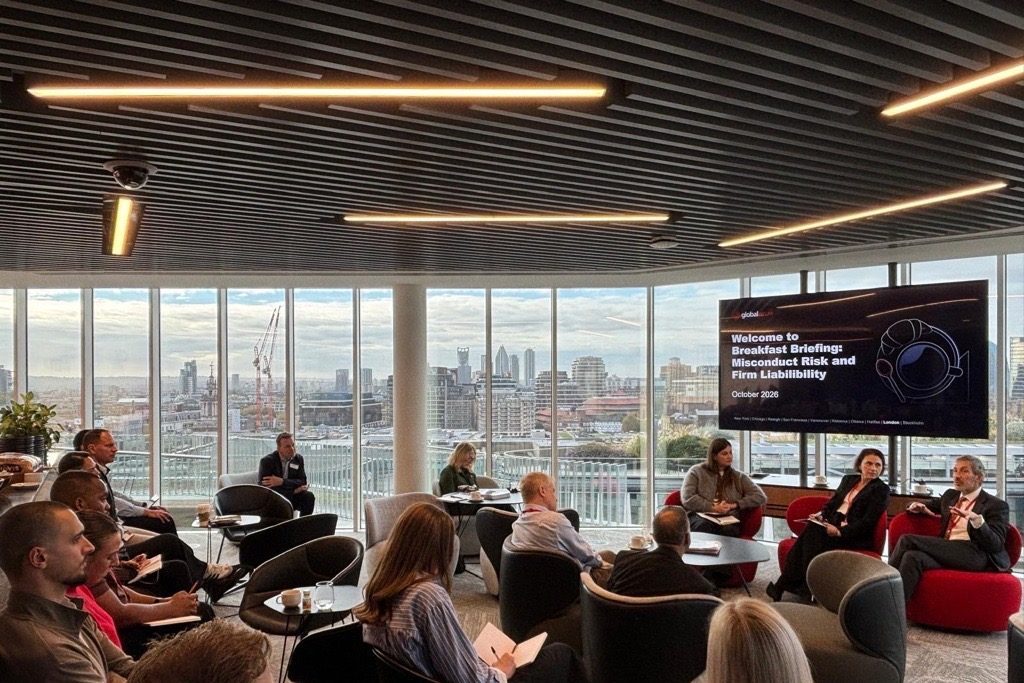

The City of London is bracing for a tense festive party season as the FCA demonstrates a zero-tolerance approach to non-financial misconduct (NFM) that extends far beyond traditional trading environments.
The regulator’s willingness to aggressively police off-duty behavior was laid bare last month when it banned Joseph Molloy, a former HSBC executive, from the financial services industry after he dodged nearly £6,000 ($8,022) in train fares. The FCA ruled that his private fare evasion demonstrated a lack of honesty and integrity that rendered him unfit to perform regulated activities.
The Molloy case served as a sobering backdrop to a recent compliance briefing hosted in London by GRIP’s parent company Global Relay, where regulatory experts warned that upcoming corporate holiday parties will act as a melting pot for the FCA’s strict new NFM rules.
Under the regime, misconduct such as bullying, harassment, or aggression is explicitly tied to a professional’s fitness and propriety. “In some ways, these are a bit of a formalization of what we have seen regulators applying pressure to firms to do over at least the last two or three years,” John Higgins, partner at regulatory consultancy Pathlight Associates, told attendees. Such incidents, he added, are viewed as “indicative of whether the business has an appropriate risk management culture.”
Breaking down silos
The regulatory shift forces financial institutions to confront the collapse of the wall between private and professional lives. Maria Symeon, a business psychologist and partner at Pathlight, noted that tying conduct and risk together requires a fundamental change in working practices.
“I think that HR and compliance need to work better together to manage this,” Symeon said. In serious cases, they must also bring in legal teams to assess liabilities and reporting duties. It is no longer viable for NFM to remain a siloed human resources grievance.
This risk is particularly acute in the era of hybrid working. With employees lacking the daily face-to-face familiarity of the traditional office, the sudden context shift of a festive gathering can quickly erode boundaries.
“Social events naturally break down barriers, they break down workplace barriers,” Symeon said. “Any cultural weakness that exists is going to come out in that situation just because the barriers are reduced… The minute people go outside the office, there’s a context shift.”
Generational divides and leadership accountability
For the FCA, how a firm manages these blurred lines is the ultimate barometer of its psychological safety. Unchecked NFM at corporate parties or even on personal social media feeds can destroy the internal “speak-up” culture required to flag broader systemic financial risks.
Higgins pointed out that generational shifts have fundamentally changed what is acceptable, noting that “the workplace is a lot more diverse than it used to be.” While older generations may have previously normalized heavy daytime drinking, a modern workforce often expects a different standard. Older leaders must update their mental models to avoid projecting outdated norms onto younger staff.
Crucially, executives can no longer rely on slipping away from the holiday party early to evade accountability for unruly staff. “If you’re a senior manager at an event and out of hand behavior is making people uncomfortable, deciding to walk away rather than do the uncomfortable thing of speaking up is not acceptable,” Higgins warned. “It’s not preventing the harm.”
The SMCR paradox
Yet, despite the regulator’s aggressive posture, an impending regulatory paradox threatens to undermine the regime.
Recent consultations on streamlining the Senior Managers and Certification Regime (SMCR) have proposed eliminating the “certified function” requirement. This tier covers the vast majority of mid-to-senior City workers who are subject to fitness and propriety checks, the exact demographic most vulnerable to NFM scrutiny.
Higgins warned that removing this certified population “significantly weakens both the regime within the firm to monitor operational misconduct, but also blinds regulators to what firms are doing because it removes a whole level of reporting.” If the tier is scrapped, firms could find themselves legally exposed when attempting to provide regulatory references regarding an employee’s historical behavior, and left without a formal framework to anchor their assessments.
Global nuance and investigations
The rules also present headaches for global institutions attempting to enforce UK standards, described by Symeon as “probably the strictest in the world,” across a diverse international workforce. Higgins advised global firms to focus on universal behavioral standards rather than UK-specific regulatory jargon, noting that firms must adapt to different cultural norms regarding corporate hierarchy and communication styles.
When incidents do occur, the handling of the immediate aftermath is critical. Higgins warned against HR teams trying to force a consensus among conflicting, alcohol-affected memories. “What you do in the first 48 hours is critical,” Higgins advised. “Just get down people’s factual recollections. Worry about how they’re all different and how you address that later. Don’t start trying to reconcile and normalize accounts… because then it looks like you’re trying to produce a company view.”
To police these boundaries year-round, firms are increasingly turning to artificial intelligence to scan internal communications. However, the panel cautioned against a “Big Brother” approach. During technology trials, some institutions have balked at the sheer volume of infractions uncovered, with executives demanding vendors “turn this off right now.”
Instead, Higgins suggested a more constructive approach. Firms should use AI to scan for positive signs of a healthy culture, such as managers encouraging questions and responding constructively to challenges, as a measure of psychological safety, rather than solely hunting for profanity.