


The investors to inherit Britain’s wealth over the next few decades do their research on social media, and more of them trust an AI tool than trust the press. That’s not a forecast. It’s the FCA’s own survey data from the last two years.
Here’s the other half of the picture, from the banks and brokerages we work with. Roughly 20% of their total staff are subject to rules and regs on external communications. Of those, only a tiny portion are in a compliance tool the firm has in place (assuming there is one in place, which there often isn’t). And it’s not like the rest of them aren’t doing anything. The majority of people are active every single day on social, LinkedIn included.
So the clients moved, the advisers are already there, and the firm is the only party not in the room.
Enabling staff to use social media in a safe, effective, and compliant manner is all we do at EveryoneSocial. It’s all we’ve done since 2012, and for most of that time the conversation with financial services firms ended the same way. Marketing wanted to do more. Compliance said no. Everyone agreed to revisit it next year. And honestly, compliance was right. The tools built for regulated firms are incomplete and clunky, the downside was obvious, the upside was fuzzy, and if it’s your name on the line when something goes wrong, “no” is a perfectly rational answer.
What’s changed is that the upside isn’t fuzzy anymore, and “no” has quietly stopped being the safe option.
The clients moved
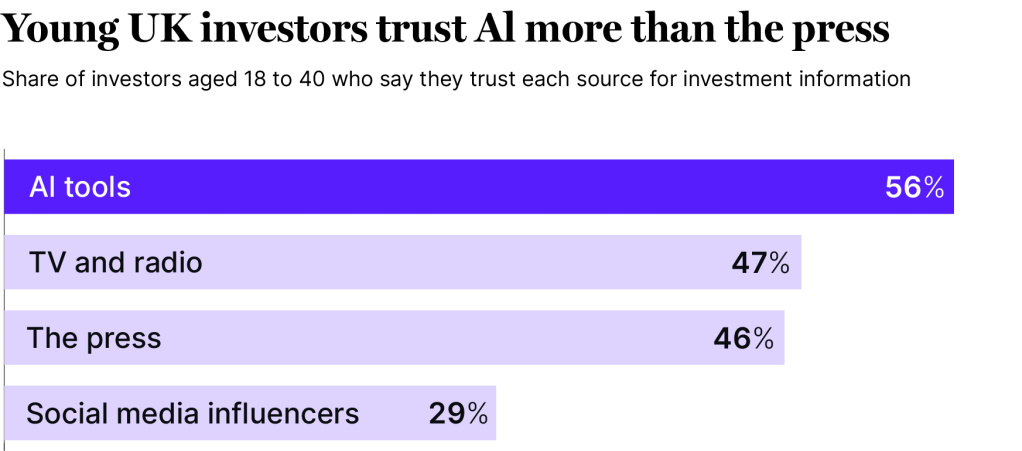
The numbers deserve a closer look, because the shift is faster than most firms assume. In 2024 the FCA polled 2,000 UK investors aged 18 to 40; 43% said social media is their PRIMARY research tool for investments, and two-thirds make an investment decision in under 24 hours. This August the regulator went back to the same age group and asked about AI. Four in five of the less experienced investors had already used it for help with investing, and 56% said they trust AI tools, against 47% for TV and radio, 46% for the press, and 29% for the influencers they follow.
Across all UK investors the numbers are smaller, and the UK is still a conservative market. Boomers hold more than half of the wealth in Britain and they are not asking ChatGPT where to put it. But something like £5.5 trillion ($6.69 trillion) will pass between generations in the UK over the next few decades, and Capgemini found that 81% of inheritors plan to switch firms within a year or two of inheriting. Where do you think those heirs find their next adviser? Not in a brochure.
Who’s talking to them?
Not the people who should be.
By our estimate, the typical regulated program reaches under 5% of staff who are subject to monitoring. The other 95%, the advisers, bankers, and agents who actually hold the client relationships, are either 1) not being monitored even though they are likely active on networks like LinkedIn, or 2) sitting out. Both of those are not good. The former is risk and the latter is lost opportunity.
So someone else fills the space. In 2024 the FCA had nearly 20,000 financial promotions amended or withdrawn, almost double the year before, and interviewed 20 finfluencers under caution. In February seven of them were sentenced for promoting an unauthorized FX scheme. Combined Instagram following: 4.5 million. Those followers weren’t getting their information from a chartered adviser. There wasn’t one in the feed.
People beat pages
Here’s a number I like to share, because it changes the conversation.
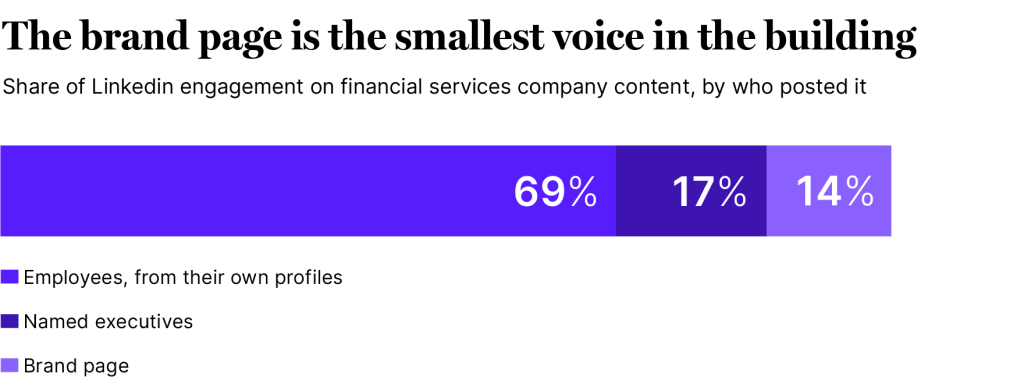
We looked at 41 million LinkedIn engagements on company content across 280 companies over the last twelve months and sorted them by who did the posting – an employee from their own profile, a named executive, or the brand page. In financial services, employees drew 69% of the engagement. Executives drew 17%. The brand page drew 14%, and that was the brand page’s best showing in any industry.
The brand page is the smallest voice in the building. It’s also the one most firms spend the money on. Brand is pay to play now. The networks suppress it unless you put dollars behind it, and an employee’s post costs roughly nothing at the margin.
Trust works the same way. Edelman asked UK consumers whom they trust to give them accurate information about a brand – the answer came out as employees 56%, journalists 50%, the CEO 45%, influencers 37%. And the AI models lean the same way. Meltwater, working with LinkedIn, looked at 9.5 million AI citations this year and found that about 75% of the LinkedIn content the models cite comes from individual profiles, not company pages. It varies by tool, from a bit over half on ChatGPT to over 80% on Google’s AI answers, but the direction is the same.
So when a 30-year-old asks an AI which wealth manager to talk to, the answer is being built mostly from what people posted. If your advisers are silent, your firm isn’t in the answer.
What the firm actually gets
Two teams feel this first – marketing and sales. Marketing, because the firm’s message finally reaches people the brand page doesn’t. Sales, because the advisers are the ones doing the reaching.
I’ve been an honorary salesperson my whole career, and the one thing I know is that people buy from people they know, like, and trust. An adviser who posts a sensible take on rate cuts once a week is not going viral. She is staying visible to 800 people who might one day need to move a pension, and to the two or three who are thinking about it right now. That’s the entire mechanism. It’s word of mouth, running every day.
And the numbers are real. One of our customers, a software company with about 4,000 staff, went into its CRM and found that organic social had influenced $5.8m in revenue over 12 months – $5.2m of that came through the advocacy program. Another, a 20,000-person enterprise, took the 150 accounts its CMO cared about most and found that every one of them had people engaging with staff and executive posts in a single quarter. For the brand page, that figure was around 15%. Whatever size your program is, scale those numbers to it.
Compliance holds the keys
None of this works unless compliance is in the room, and I don’t mean signing off at the end. I mean compliance and marketing at the same table from the start, with compliance holding the keys and marketing holding the objective. The firms getting this right treat it as one program, not a negotiation.
What’s different now is that visibility and control stopped being a trade-off. The controls sit in front of the post, not behind it. Disclosures are appended automatically, because no one remembers a disclaimer. Pre-approval happens where it’s required, and only where it’s required. Blocklists catch the words, topics, and tickers a firm can’t have in the feed. Every post, comment, and edit is captured, whether it went out through our platform or straight from LinkedIn, and all of it is archived and supervised through the systems compliance already runs, with a full audit trail. When the regulator asks, the record is already there.
This is why global financial institutions like HSBC have chosen to enable their people on social media through EveryoneSocial. The thing that made it possible wasn’t a marketing budget. It was a compliance team deciding they’d rather see the activity than pretend it wasn’t happening.
Governance done right isn’t a brake. It’s the thing that lets compliance say yes by default. And when the default is yes, people post.
Your next client is already on social, asking questions. The only decision left is whether one of your people is there to answer.
Cameron Brain is CEO and co-founder of EveryoneSocial.